
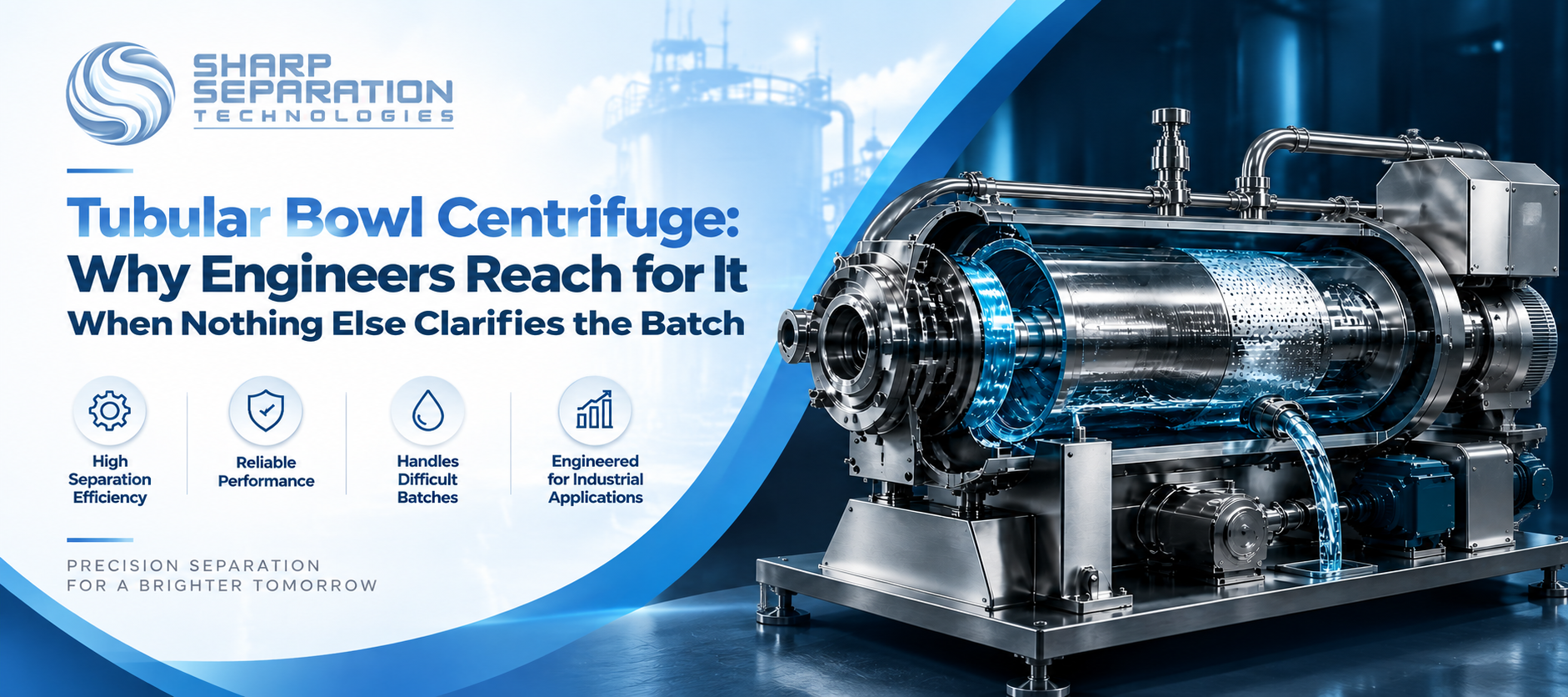
You've probably already tried the obvious fix. A standard centrifuge, a longer settling tank, maybe a filter press. And the liquid still comes out cloudy, because the particles you're chasing are too fine and too sparse for gravity or even a normal spin cycle to catch.
That's the exact situation this piece of equipment was built for.
What Is a Tubular Bowl Centrifuge ?
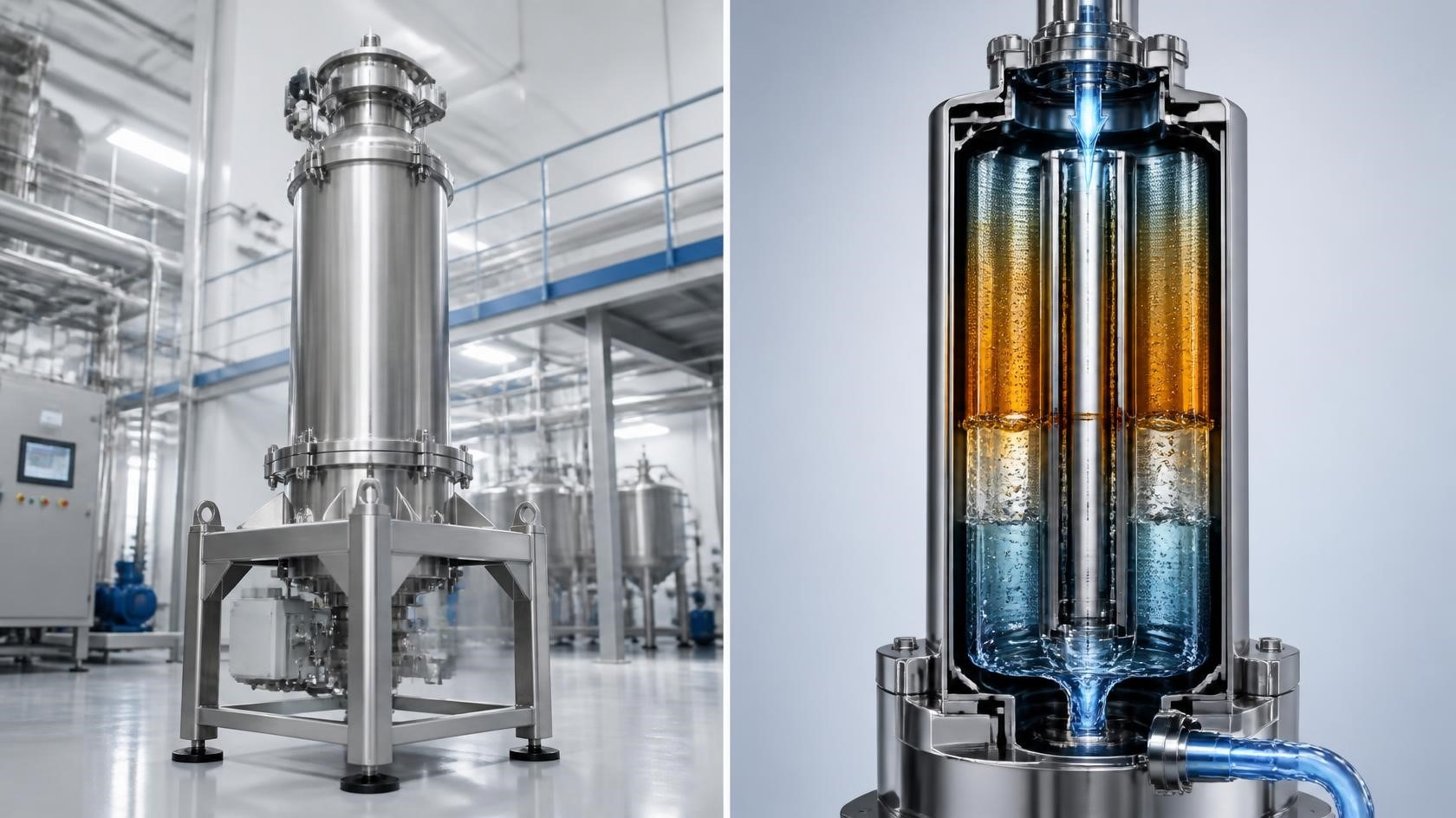
A tubular bowl centrifuge is a high-speed centrifugal separator that uses a narrow, elongated rotating bowl to separate fine solids from liquids or two immiscible liquids from each other under extreme G-forces. Its small diameter and long length let it spin far faster than a standard basket centrifuge, generating anywhere from 18,000×g in industrial units up to 65,000xg in laboratory models.
That number is the whole story. Most industrial centrifuges top out well below 10,000 x g.
This machine operates in a different class entirely, which is why it shows up in processes where the density difference between phases is razor-thin: plasma from blood cells, catalyst fines from polymer solvent, wax from lubricating oil.
How the Separation Actually Happens
Feed slurry enters near the base of the bowl. The bowl spins at high RPM, and the resulting centrifugal field forces denser solids outward against the bowl wall while the clarified liquid moves toward the center and exits through an outlet near the top. In three-phase versions, a heavy liquid and a light liquid stratify into separate rings before the solids ever reach the wall, each phase drawn off through its own outlet.
We won't re-walk the full mechanical breakdown here — bowl tolerances, spindle coaxiality, bearing lubrication — because that's a maintenance-manual conversation, not a buying one. If you're already spec'ing bowl assemblies down to the millimeter, you're past this article.
What matters at this stage is picking the right category, and that means understanding what a tubular bowl centrifuge does that its two closest relatives don't.
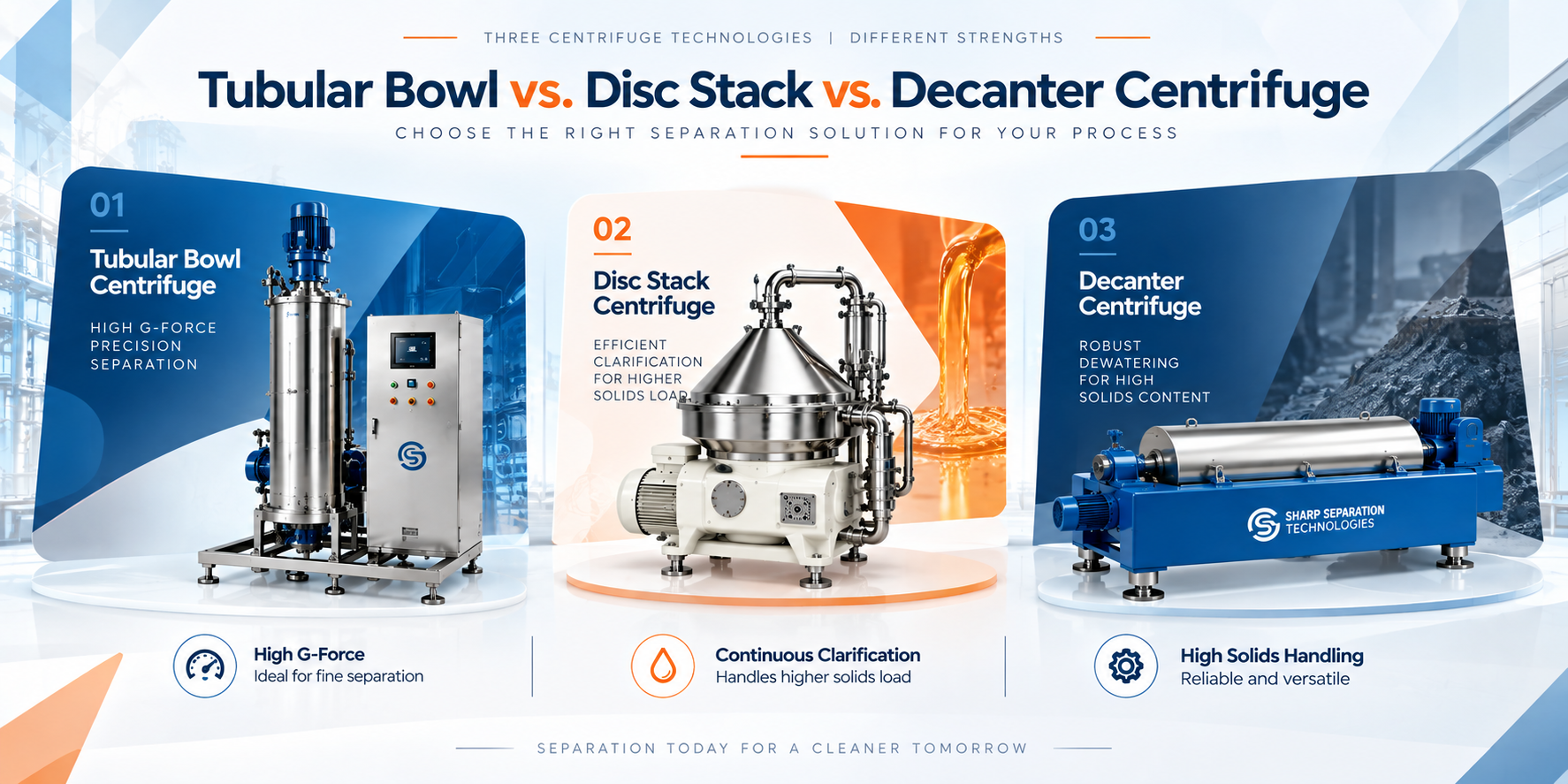
Tubular Bowl vs. Disc Stack vs. Decanter Centrifuge
Typical G-force
15,000–65,000×g
5,000–15,000×g
1,500–4,000×g
Best for
Trace solids, fine particles, low concentration
Continuous clarification, higher solids load
High solids concentration, dewatering
Solids discharge
Manual (or skimmer/knife-assisted)
Automatic (nozzle or intermittent)
Continuous (screw conveyor)
Feed suitability
Dilute, low-viscosity
Moderate solids, moderate viscosity
Thick sludges, slurries
If your feed is mostly liquid with just a whisper of fine solids, this design will out-clarify a disc stack machine every time — the tighter bowl radius simply generates more G-force for the same footprint. Once solids load climbs past a few percent, though, you'll be shutting the bowl down constantly to clear it, and a decanter or disc stack unit becomes the more sensible investment.
That trade-off, brutal clarity versus batch-limited capacity, is the single most important thing to understand before you spec one.
Discharge: Manual, Skimmer, or Knife
Most units in this category rely on periodic manual shutdown to remove accumulated solids cake. Some designs add a skimmer pipe that draws off the clarified liquid layer above the solids without stopping the bowl, and a small number use a knife discharge for compacted cake that won't flow on its own. None of these turn the machine into a fully continuous unit. You're still managing a solids ceiling — but skimmer and knife options cut downtime noticeably on processes with a steady, predictable solids load.
Where These Machines Actually Get Used ?
- Pharmaceutical and blood processing - plasma separation, vaccine and antibody clarification, where fine biological solids at low concentration have to come out without shearing fragile cells.
- Edible oil refining - polishing oil after primary separation, pulling out trace waxes and gums that a coarser process leaves behind.
- Fermentation and biotech - clarifying broth after fermentation, separating cell debris from the target product.
- Beverage and food processing - juice and beverage clarification where clarity is a quality spec, not just a nice-to-have.
- Nuclear fuel reprocessing - removing fine solid particles from solvent after spent fuel dissolution, a niche but well-documented application in high-G sedimentation.
- Industrial oil purification - recovering and polishing lubricating and hydraulic oils contaminated with fine wear particles.
Notice the pattern : every one of these is a low-concentration, fine-particle problem. That's not a coincidence — it's the design brief.
How to Choose the Right One for Your Process ?
Sizing one correctly comes down to four questions, and we'd rather you ask them before you buy than after:
1. What's your solids concentration ?
Above roughly 1–2% solids by volume, expect frequent downtime for manual cleaning unless you add skimmer/knife discharge.
2. How fine are the particles, and how close are the two densities ?
The finer and closer, the more G-force you need — this is where tubular bowl models earn their keep over disc stack alternatives.
3. What's your required throughput ?
Bowl diameter and length set your flow-rate ceiling. A machine sized for lab-scale clarification won't keep up with a production line.
4. Two-phase or three-phase
If you're separating oil, water, and solids simultaneously, you need a three-phase (GF-type) bowl with dual liquid outlets, not the simpler two-phase (GQ-type) design.
Get these four answered honestly and sizing conversations with a manufacturer go from guesswork to a five-minute call.
Frequently Asked Questions
Everything You Need to KnowIndustial units typically reach 18,000×g, while laboratory-scale versions can exceed 65,000×g, well above what disc stack or decanter designs achieve.
Liquid discharge is continuous, but solids removal is batch — the bowl must be periodically stopped (or skimmed) to clear accumulated solids cake.
GQ refers to the two-phase, solid-liquid design. GF refers to the three-phase version that separates a light liquid, heavy liquid, and solids simultaneously.
Not well. Higher viscosity slows particle settling and blurs the phase interface, so these machines perform best on low- to moderate-viscosity feeds.
Send us your feed composition, solids concentration, and target throughput, and our applications team will size the right two-phase or three-phase unit for you — no obligation, just a straight answer.